Designing an Offers & Discounts module for MSME Sellers
Scope
-
Competitive analysis
-
Flow mapping
-
Iterative design
-
UX & Visual Design
Overview
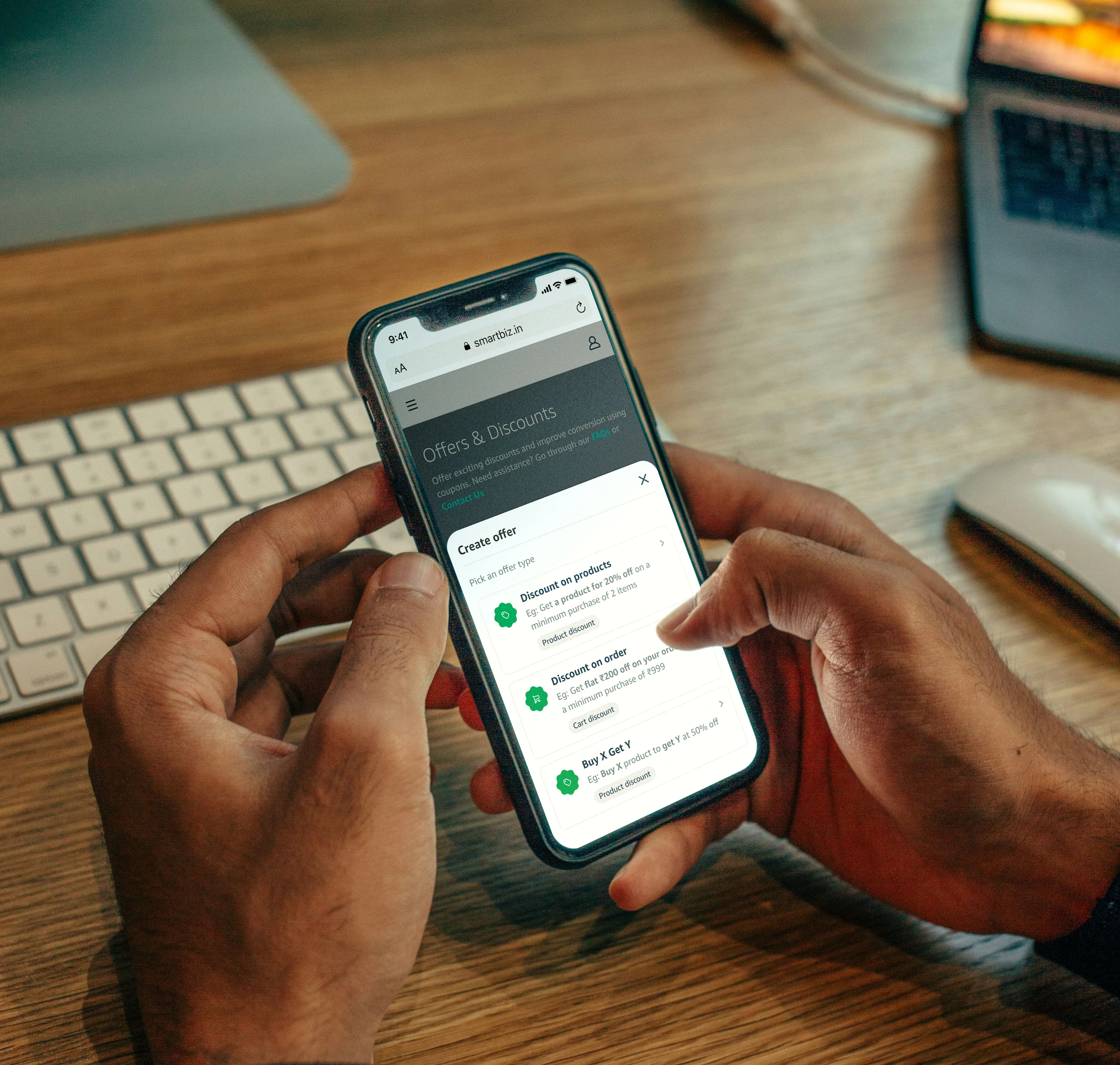
SmartBiz is a no-code platform that allows small and medium-sized enterprises (MSMEs) to build and manage their own online store while taking advantage of Amazon's e-commerce infrastructure. Sellers can list their products, drive sales, move inventory and build an online presence. A key part of this is driving repeat purchases - and one of the ways to achieve this is through offers and discounts.
The Problem
One of the primary goals of our sellers was to create "running promotions", which helped improve conversion rates on their websites. Existing systems on other platforms felt complex and time-consuming. Considering these sellers are setting up an online store for the first time, we needed to create a way for them to drive these promotions easily and effectively.
Part 1: Benchmarking & Understanding Seller Pain Points
Analysing the competitive landscape helped me understand existing patterns. My primary goal was to identify why these systems didn't seem friendly to a new seller.
Key findings of common seller problems while creating an offer:
-
Decision Paralysis
Sellers are often presented with a lot of technical options at once ("percentage," "fixed amount," "BOGO," "cart discount," "product discount," etc.). They don't know where to begin, and fear making mistakes.
→ Simplify their choices or reduce the number of them, and focus on helping them create an offer and promote it as fast as possible.
-
Lack of Confidence
Sellers are often afraid of making errors, especially if it's their first time working with an online store. Their questions often sounded like: "Did I set this up right?", "Will I lose money?", "What will my customer see?", which discouraged them from exploring a feature like this.
→ Provide guidance at every step so they clearly understand what's going on.
-
Inability to Target Certain Customers
Sellers often used social media channels to promote exclusive deals for loyal customers. They did so strategically, so that they don't risk eating into profits.
→ Helping them "close the loop" after offer creation by sharing the coupon code with potential customers.
Part 2: The Framework
I quickly realised that this module would be a complex system of logic. My first deliverable was a detailed framework, created in close collaboration with my product manager which acted as the source of truth that defined:
Offer Types
The system would be designed around three simple seller goals: Discount on a Product, Discount on the Cart, and a "Buy X Get Y" (BXGY) offer.
Nested Logic
Technical choices like "percentage discount" vs. "flat discount" were defined as secondary steps within these offer types, and not as a primary choice.
Eligibility & Rules
A clear system for defining product eligibility (e.g., specific SKUs, categories or product collections), customer eligibility (first-time vs. returning), and coupon usage limits.
Offer Trigger Logic
Defining how discounts on products vs. cart would be applied, automatic vs. manual application, and the priority of application.
Offer Stacking
An option to easily allow sellers to combine one offer with another. For example, could a '10% off on cart' coupon be combined with a 'Buy 1 Get 1 Free' product offer?
Content & Display
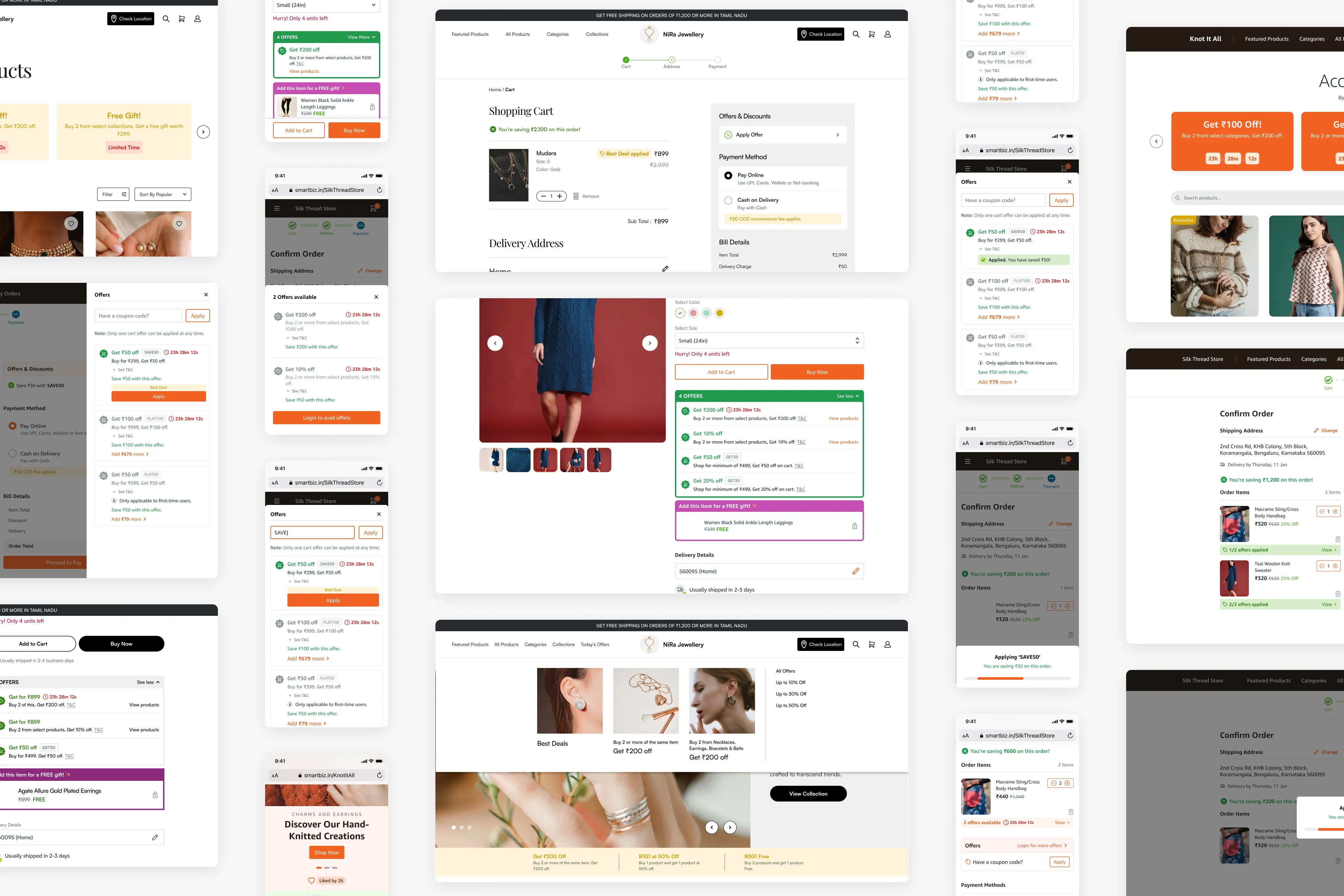
Finally, a templated text format and thematic visual elements for every touchpoint (homepage, collection, category and product pages, cart) to ensure consistency.
Part 3: User Journeys & User Flows
With the logic defined, I mapped the seller-side and customer-side experiences. As with any UX process, the idea behind the seller flow was to reframe the "offer creation" around the seller's goals of being able to confidently create and share discounts with customers.
I made sure the discounts were communicated clearly (with a bit of urgency) at important stages of their journey—from discovery (banners, "expiring soon" widgets, etc.) to consideration (using reward-oriented language, showing additional offers, etc.) to conversion (easy-to-read offer details in the cart).
Solving Decision Paralysis
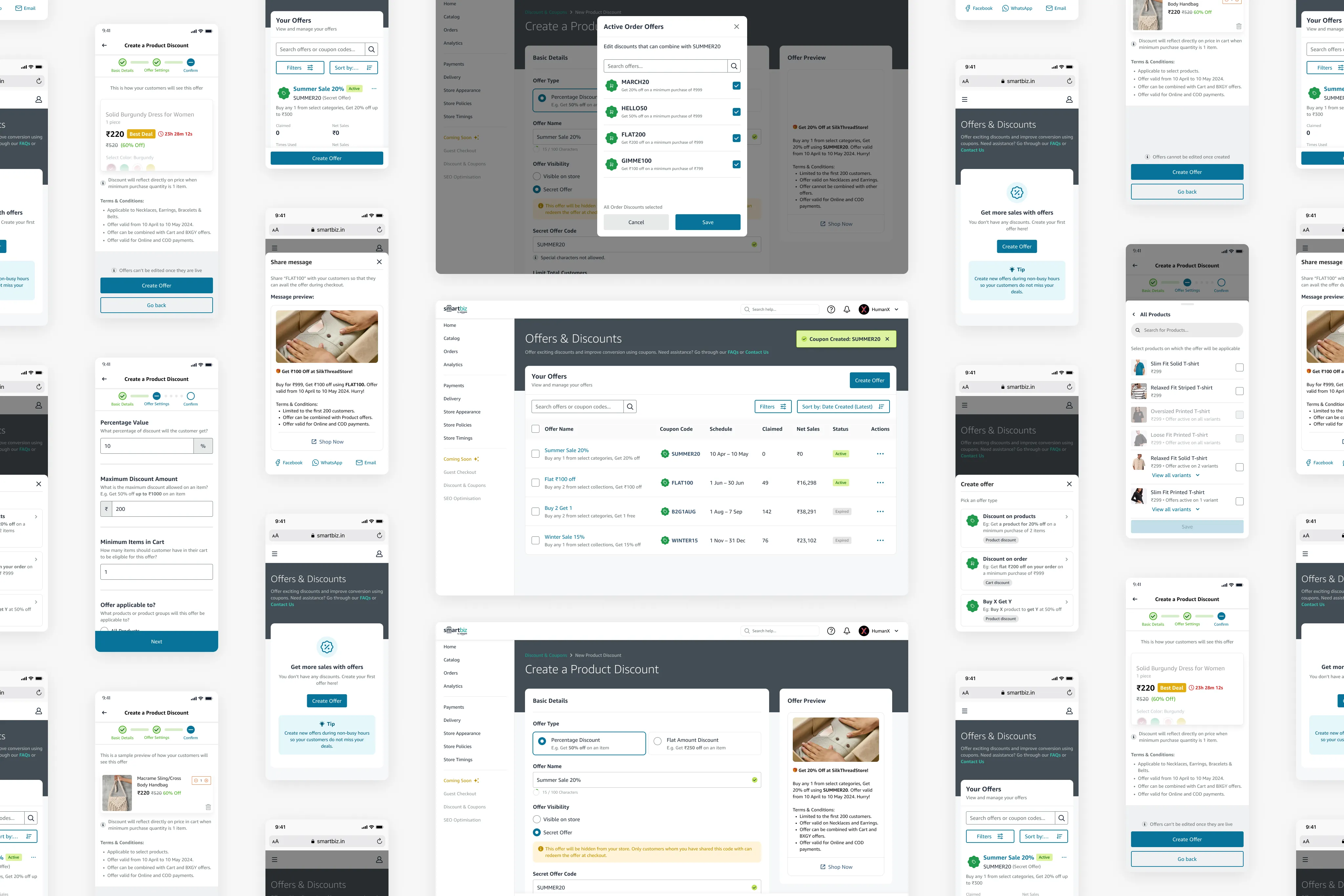
Guidance was embedded into the offer creation process. Tooltips explained why certain settings were important, with "smart summaries" showing a summary of their choices. For example, when the seller sees "Offer will be visible to [all customers] and [applied automatically] at checkout", it confirmed their understanding of what they were doing.
Creating Offers Confidently
As the seller progressed through the flow, a widget (the same one used on the storefront) on the side of the screen updated in real-time. For example, if they selected a percentage discount of 25% on their entire catalogue, the widget would show "25% off on all products!"—exactly what their customers would see. This was the most critical confidence-building feature.
Target Customers and Prevent Cash-on-Delivery Fraud
"Secret Offers" was a feature that helped sellers target certain customer groups without publicising the discount. Another option allowed sellers to make the discount available only on online payments—a key request from sellers wanting to reduce cash-on-delivery (CoD) fraud.
Closing the Loop
Once the seller saved their new offer, the confirmation modal didn't just say "Success." Instead, it immediately prompted them with a clear call to action to share it on their preferred social media channels. This simple prompt closed the loop from creation to promotion, directly contributing to the seller's ultimate goal of getting more customers.
This project contains both independent and collaborative responsibilities at HumanX. The collaborative nature of studio work involves the contributions of multiple talented individuals whose combined efforts produce the final result.